
One of my primary goals in life is to teach my kids to be eventually good, productive, and self-reliant adults. One area of life-skills that my wife and I are focused on in teaching our children, is teaching them the principle of work: how to work, the value of work, to take ownership over their responsibilities, and to be proud of their accomplishments, and to learn to work as a team and family. One way we are reinforcing the principle of work is through the use of effective Visual Management.
My wife created a wonderful job chart, which you find below:
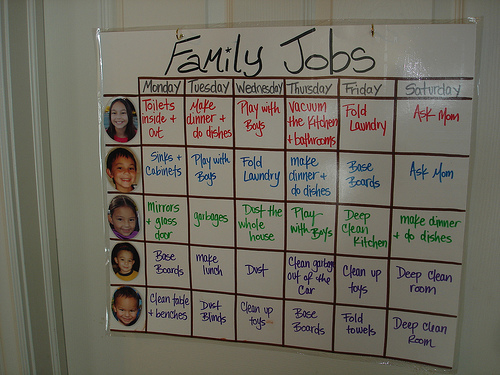
This Job Chart is in our kitchen, where there is frequent foot traffic and where our family spends most of our time. There are a few items I’d like to note:
- My kid’s ages are (from top-to-bottom): 9,8,7,3,3
- The Kid’s Heads: Visually representing each child with their face is much more effective than using their names. The Kid’s Heads are laminated and have Velcro on the back, to facilitate ease-of-job-rotation. This approach is also very environmentally friendly, since the pictures and the board are laminated — there’s no waste.
- We have jobs over 6 days — Monday through Saturday and the jobs are fixed, but the heads are rotateable. The younger boys (the twins) rotate with each other at the bottom 2 rows — those jobs are designed for their age and ability. The top-3 rows contain jobs for the older kids and those jobs are designed for their age and ability.
- Every Sunday, we rotate the heads for the upcoming week.
Deploying The Program
When my wife and I first met about this during our end-of-the-year meeting, we were quite excited and saw a lot of promise in helping our kids learn the value of work.
Plan:
- My wife and I first met together to discuss our goals for the year 2008 and how we could accomplish those goals and the expected outcomes at the end of 2008. We then brainstormed all the jobs that needed to get done in our household on a daily and weekly basis. We, then, categorized the jobs based on age and abilities of our children. For example, we had to be sensitive to the child’s height or the size of their hand and matched the work to their physical and mental abilities.
Do:
- We gathered the family together and explained our goals and vision for 2008 as it relates to the principle of work. I explained to the kids how important work is and I also shared my personal stories about the principle of work. I showed encouragement and excitement to the kids and that learning the principle of work will help them “feel big” and not little anymore.
- My wife and I explained our expectations and discussed rewards and consequences and also the start-date.
- We provided training on some jobs that the kids were not familiar with. This is especially true for my twins, as this is their first foray into a more structured world of chores and work.
Check:
- Every night during our family prayer, we discuss how the day went and how their jobs are going.
- The 3 older kids have other diversions also like homework, piano, playing the Wii, and hanging out with friends. We want to make sure that they can still do other stuff and not be too burdened by any single item.
Act:
- Depending on the findings during our daily discussions, then we adjust. For some kids, they might have to double-up on work the next day so they can do homework. We do not want to Batch work like that, but that is an option until further discussions can be had on whether there might be too much work.
Respect For The Kids
The Job Chart conveys information so that Mom and Dad don’t have to. When Mom or Dad have to convey the information, it usually ends-up as nagging. That approach is irritating, disrespectful, and polarizes people. We want, instead, to teach self-reliance, demonstrate our trust in the kids, and help them grow in their own terms, but with our loving guidance.
How Can This Be Improved?
What we haven’t done yet is to provide Standard Work Cards for each job, showing in text how to do the job and also a picture of what a “good job” looks like. One example might be to show a side-by-side comparison of a dirty toilet next to a clean toilet, with a marker on the clean toilet, indicating to the reader what the ideal finished good should look like.
Can you think of other ways could we improve?
Just So You Know
Yes, I have jobs also. My jobs are usually of the “Ask Mom” variety. This means that I get all the hard work, inconvenient errands, and other random but necessary to-do items. And, yes: my wife is pretty much the best.
Become a Lean Six Sigma professional today!
Start your learning journey with Lean Six Sigma White Belt at NO COST


Ron Pereira says
Two words for this Pete.
1. Totally
2. Awesome!
clive smit says
This was a great post.
My 5 year old son has semantic-pragmatic disorder. He learns in a totally different way to others. We have started a chart of what he has to do in the mornings and this really motivated him and took the nagging right out of things.
Your charts are more advanced… I’m definitely going to give them a bash!
Many thanks
Clive
Johan says
Pete,
I’m so implementing this, tonight. Other half is a PM, she’ll love it.
Totally made my day!
Thanks
/Johan
Ed says
I just started teaching my 3 year old visual managment. I wasn’t sure how it was going to work, so we started small. I bought a three roll toilet paper stand that sits next to the toilet. The rule is he must check it daily and when it gets down to one roll he replenishes it from the pantry in the basement, and alert Mom if the basement stock is low. It’s worked out great; he gets really excited when he can refill it and we’re never caught without TP 🙂 I’m not brave enough to try to get my wife to stop buying in bulk, so for now we’ll stick with this! Thanks for the article, I’m definitely going to try implement some of your ideas.
Kind regards,
Ed
Kevin Marshall says
We’ve got a 3yr old and I bet this would work great with him also. Any chance you’d do an update post to share how this system worked over the past year?
Discovered you via http://www.gembapantarei.com/2009/01/the_essential_lean_blogosphere_2008.html
Kevin
John Hunter says
My Dad http://williamghunter.net/ did very similar stuff with me and my brother as a kids and tried to PDSA over time. He even tried rewards (which my Mom did not like) but those were abandoned. We never did standard work cards that would have been good.
We included at least my Dad (I can’t remember if my Mom was). I think that is a nice touch. It makes it clearer it really is a team. And also can show the parents really do a lot. His tasks didn’t rotate, except as we got older different people cooked diner each night.